Explore the Reina Sofía’s modern and contemporary art with time for context, its contrasting museum buildings and a practical plan for a focused visit.
Museo Nacional Centro de Arte Reina Sofía, Calle de Santa Isabel, 52, 28012 Madrid, Spain. The museum includes Sabatini and Nouvel buildings. At the 30 October 2026 check, the museum recommended the Nouvel entrance at Ronda de Atocha, 2, for online-ticket holders; follow your current ticket instructions. The map marker identifies the museum, not a particular door.
The Museo Reina Sofía asks for a different kind of attention from a rapid tour of famous paintings. Its modern and contemporary art can introduce political history, artistic experiment and changing ways of making images. Guernica is a central reference point, but a visit gains meaning from the material around it and from works you may not have known before arriving. Choose a manageable area of interest, read the museum’s current collection and exhibition information, and let the visit develop through looking rather than a race to one room.
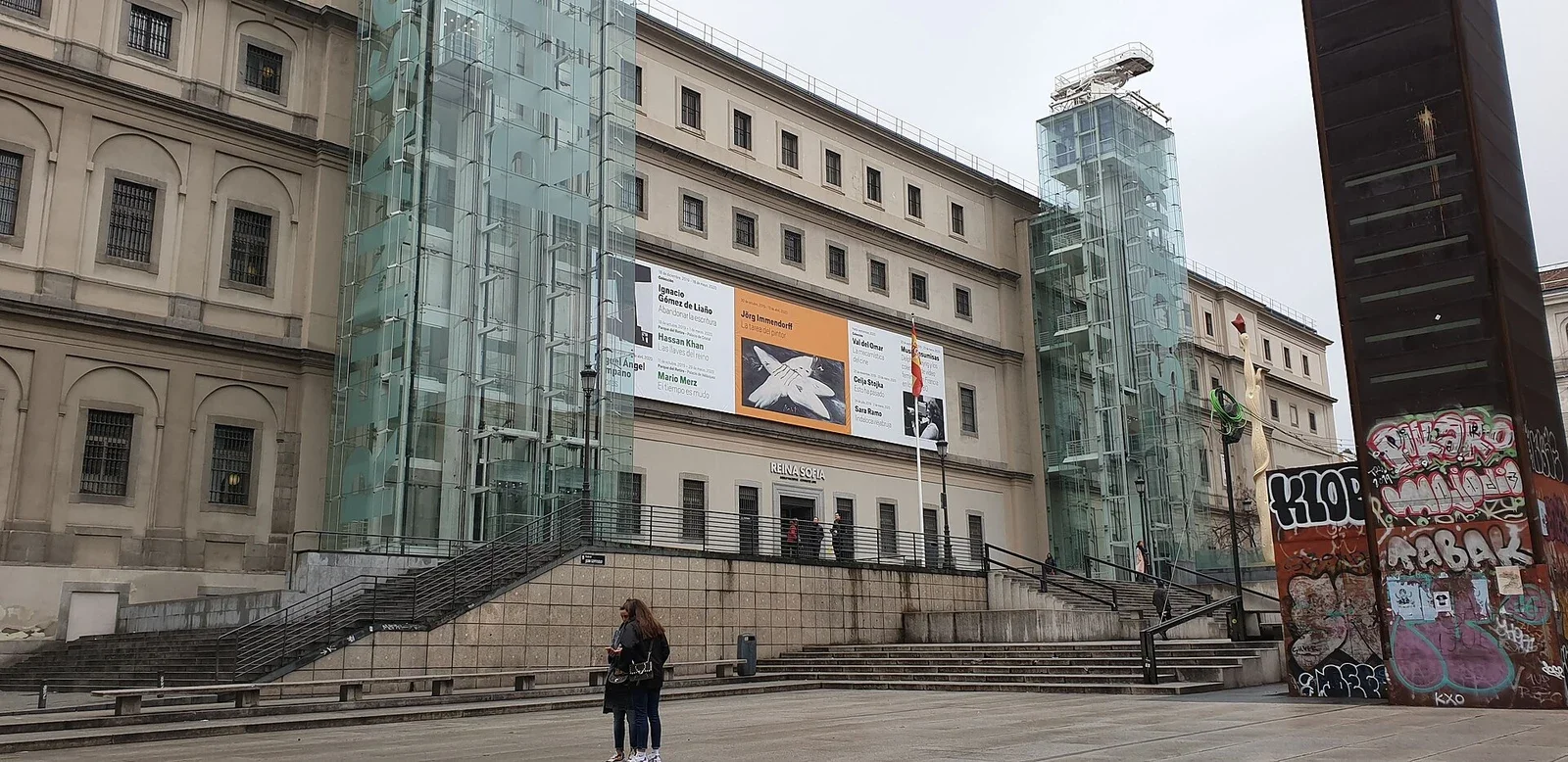
The main Sabatini Building began as an eighteenth-century hospital, a history still important to its form and scale. The museum’s development reused that structure rather than replacing the setting with an entirely new institution. In 2005, the Nouvel Building extended the complex with a contrasting contemporary language. The relationship between the two buildings is part of the visit: historic spaces, later interventions and changing cultural uses meet in one museum. Pay attention to the architecture without assuming that every space you see belongs to the same period.
A collection shaped around modern art
The museum’s own collection history explains how Picasso and Guernica became important to its narrative, with the painting transferred from the Prado in 1992. That context helps avoid treating the work as an isolated trophy. Use the current display and interpretation to understand how the museum places familiar artists alongside wider artistic and historical questions. Collection arrangements evolve; a room number in an older itinerary is not a reliable description of the route you will find.
LOOK A LITTLE CLOSER
What to notice.
01
Give Guernica its context
If Guernica is your main reason for visiting, begin with the museum’s current information and allow time for related material rather than planning only a brief encounter with the painting. Look at the work before reading everything about it, then use the interpretation to deepen what you noticed. Respect other visitors’ sightlines and the current room rules. A photograph cannot substitute for time spent understanding the scale and experience of the work.
02
Leave space for unfamiliar works
Choose another part of the collection or a temporary exhibition that interests you, even if it contains no name from your original list. Ask what a work is doing with material, movement, sound or the surrounding space. The museum offers more than one way into modern and contemporary art, and a focused personal route is preferable to trying to exhaust it. Check the display and programme for the day before deciding where to concentrate.
03
Read the meeting of old and new architecture
The Sabatini and Nouvel buildings give the museum a distinct physical character. Notice changes in light, scale and circulation as you move between parts of the complex. Architecture can become a useful pause between demanding gallery spaces rather than another box to tick. Consult the current museum plan for the route you need; the presence of a visible lift or staircase does not establish the practical route suitable for every visitor.
BEFORE YOU GO
Make your visit count.
Check the museum’s own calendar
The Reina Sofía, Prado and Thyssen-Bornemisza are separate institutions with different visiting arrangements. At the 30 October 2026 check, the Reina Sofía main-site calendar listed Tuesday as its weekly closing day. Recheck that calendar, special closures and gallery notices before reserving another activity around the visit. A combined pass or a city art itinerary does not make the museums’ calendars identical. Give this museum a meaningful block of time and allow for entry procedures and a pause afterwards.
Understand the admission product
Read what the selected ticket includes and how entry works for your date. The official visit information reviewed for this guide states that a ticket is also needed during free-admission hours. Check the current booking route, eligibility evidence and any capacity conditions rather than assuming that free access means arriving without preparation. This guide does not promise a permanent admission price or immediate entry.
Separate the main museum from Retiro venues
The Reina Sofía also uses exhibition venues in Retiro, but they are not the same visit as the main museum complex. At the 30 October 2026 check, the Crystal Palace interior remained temporarily closed for architectural improvements. Recheck each venue’s information if your plans depend on it. A ticket or photograph associated with the museum should not be read as proof that every one of its buildings is open.
Prepare access and visitor requirements
Check the current museum plan, entrance and assistance information for the needs of your group. Confirm the final connection from your transport stop and the way back after the visit. Follow staff instructions and the rules for photography, equipment and personal belongings in each space. The licensed exterior photograph accompanying this guide has its own attribution; it does not grant reproduction rights for artworks in the galleries.
Museo Nacional Centro de Arte Reina Sofía, Calle de Santa Isabel, 52, 28012 Madrid, Spain. The museum includes Sabatini and Nouvel buildings. At the 30 October 2026 check, the museum recommended the Nouvel entrance at Ronda de Atocha, 2, for online-ticket holders; follow your current ticket instructions. The map marker identifies the museum, not a particular door.
Use the museum’s official directions for the relevant building and visit. Check the current transport service to the Atocha/Estación del Arte area, the final street connection and any accessibility requirements before travelling.
An original AI-assisted guide checked by TourPedia before publication. Visiting arrangements can change; use the official visitor links before travelling.
MAKE YOURSELF AT HOME
Stay near Museo Reina Sofía.
A curated collection of places to consider around this area.
Curated hotels for this area are not available yet.
Distances are approximate straight-line measurements from the Museo Reina Sofíaarea marker, not walking routes. This is a small researched collection, not all nearby hotels. Check rates and availability on the hotel website.
A TASTE OF THE NEIGHBORHOOD
Where to eat near Museo Reina Sofía.
Find a meal that fits your visit, with official contact links.
 Culture & history