Madrid, Spain · Historic square

Plaza Mayor, Madrid

Read Madrid’s historic central square through its arcades, painted façade and rebuilt architecture, with an unhurried route into the surrounding streets.

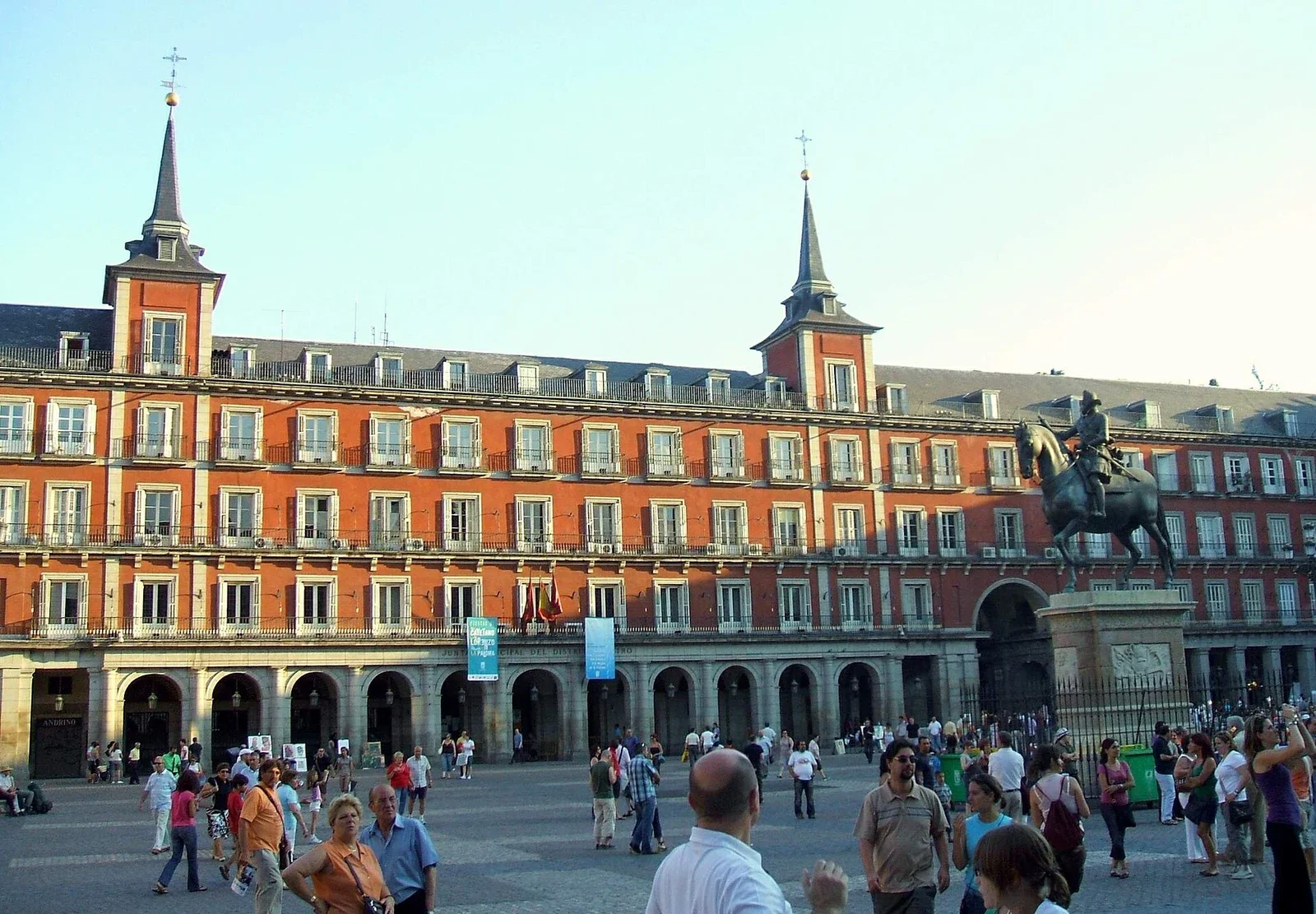
People in Madrid’s Plaza Mayor, with red facades, arcades and the equestrian statue of Philip III.Plaza Mayor, 28012 Madrid, Spain. The recorded location marker identifies the square. Its approaches differ; the Arco de Cuchilleros includes steps and should not be assumed to be a step-free entrance.
Plaza Mayor in an archival photograph whose source records 10 March 2011; square furnishings and visitor activity may differ today. Photo by Zarateman / Wikimedia Commons / CC0 1.0. Resized and converted to WebP; covers and cards may crop. / Wikimedia Commons · CC0 1.0 · Cropped for display; converted to WebP.
WHY IT MATTERS

Why this place matters.

Plaza Mayor is most rewarding when you look beyond the first complete view of the square. Its uniform fronts, arcades and entrances create a deliberately enclosed space in the historic centre, while shops, terraces and pedestrians keep it part of ordinary city life. Walk beneath the porticos, notice how the surrounding streets enter the plaza and pause where you can see the whole arrangement. It is a useful beginning for an outing in historic Madrid, but it need not become a hurried crossing between other appointments.

Place typeHistoric square
THE STORY BEHIND THE PLACE

How this place came to be.

A square repeatedly remade

The present square developed from the earlier Plaza del Arrabal, a market space. Its architectural form took shape under Philip III, and later fires led to further rebuilding. After the devastating fire of 1790, Juan de Villanueva reshaped the enclosure and its approaches. The result should be read as a place with several historical layers, rather than an untouched seventeenth-century scene. What seems uniform from the middle of the square also records decisions made in different periods.

Ceremony, trade and difficult history

Madrid’s official visitor account describes a long range of uses, from markets and public celebrations to royal occasions, bullfights and events associated with the Inquisition. That variety gives the architecture a context: this was a highly visible stage for city life and authority. The square’s present appeal should not flatten all those uses into one picturesque story. Looking carefully and reading the history can make an otherwise brief stop more substantial.

LOOK A LITTLE CLOSER

What to notice.

  1. 01

    Look closely at Casa de la Panadería

    The twin-towered Casa de la Panadería gives one side of the plaza a strong focus. Its façade carries mythological paintings by Carlos Franco, and the building has served several functions during its history. Notice the relationship between the decorated surface, the repeated windows and the rest of the square. Do not assume that every visible part belongs to the building’s earliest phase. The interest is in how the structure has been used and reinterpreted over time.

  2. 02

    Use the Philip III statue to read the space

    The equestrian statue of Philip III provides a useful point from which to understand the square’s proportions and sightlines. The monument predates its placement here, another reminder that the scene was assembled across time. Walk around it without blocking other people’s routes, then compare the view from the centre with the experience beneath an arcade. Those two positions show different relationships between the formal enclosure and its everyday use.

  3. 03

    Follow an entrance into the surrounding streets

    The Arco de Cuchilleros is a particularly recognizable approach, with steps connecting the square to a lower street. Look at that change of level rather than treating the arch only as a picture frame. Other approaches offer different connections into the historic centre. If stairs are unsuitable for your group, investigate an alternative route instead of assuming every entrance is equivalent. Choose the exit that serves the rest of your outing.

BEFORE YOU GO

Make your visit count.

Visit as a public space, with conditions that can change

A normal walk into the square is different from entry to a particular business or event. Public programming, temporary installations, barriers and busy periods can alter how the plaza feels and how you move through it. Check current city information if your plans depend on a market, concert or celebration. An archival photograph of an open space does not guarantee the same arrangement on your date.

Let a pause become part of the visit

If you choose a terrace, café or restaurant, read the actual menu, prices and service conditions before ordering. This guide does not select a researched dining venue or establish current availability. You can also enjoy the architecture without making a purchase. Give the place time in a way that suits your needs rather than assuming a particular meal or table is required to experience the square.

Connect a small area of the historic centre

Plaza Mayor can be combined with nearby historic streets and a later visit elsewhere in central Madrid, but the connection should serve a clear purpose. Select one or two further places rather than collecting every name that appears on a map. Leave room to navigate, rest and return to your accommodation. The Royal Palace is a separate visit with its own ticket and official-event closures, not an automatic extension of a walk through the plaza.

Check the actual street approach

Consult the current transport journey and choose a street entrance appropriate for your group. Madrid tourism lists Sol, Ópera and Tirso de Molina among approaches, but the best option depends on where you begin and which side of the square you want. Confirm the last part of the walk, any steps or slopes that matter and the return connection. The location marker describes the square, not a particular meeting point or accessible doorway.

Official hours & tickets
FIND YOUR WAY

Find Plaza Mayor, Madrid.

Plaza Mayor, 28012 Madrid, Spain. The recorded location marker identifies the square. Its approaches differ; the Arco de Cuchilleros includes steps and should not be assumed to be a step-free entrance.

Plan a current journey to an appropriate street approach. Madrid tourism lists Sol, Ópera and Tirso de Molina as nearby stations; check current services, the final walk and any access needs rather than selecting by station name alone.

Open location in Google Maps The marker identifies the monument area. Follow the entrance shown on your booking.
CONNECT THE STORIES

Explore around Plaza Mayor, Madrid.

An original AI-assisted guide checked by TourPedia before publication. Visiting arrangements can change; use the official visitor links before travelling.

MAKE YOURSELF AT HOME

Stay near Plaza Mayor, Madrid.

A curated collection of places to consider around this area.

Explore nearby stays

Curated hotels for this area are not available yet.

Distances are approximate straight-line measurements from the Plaza Mayor, Madridarea marker, not walking routes. This is a small researched collection, not all nearby hotels. Check rates and availability on the hotel website.

A TASTE OF THE NEIGHBORHOOD

Where to eat near Plaza Mayor, Madrid.

Find a meal that fits your visit, with official contact links.

Explore nearby food

Curated dining places for this area are not available yet.

A small researched collection, not all nearby restaurants. Confirm menus, opening hours and reservations with the restaurant.

GO BEYOND THE POSTCARD

A closer look at Madrid.

A little context. A new perspective. Somewhere worth knowing.

View all stories